
Cervical Cancer Screening Strategies

Understanding Cervical Cancer in the United States

The pap test is a significant accomplishment in cancer screening history, cutting cervical cancer deaths by more than 70% since its introduction 80 years ago.1,2 Unfortunately, incidence of cervical cancer is no longer declining, making it essential that healthcare professionals continue to utilize the most comprehensive screening approaches available.2

4,320

estimated deaths in 20253

13,360

estimated new
cases in 20253

7.7

incidence rate in
2017–20213*

USPSTF 2018 Guideline Recommendation4

For women ages 21–29 years:

Check

Screening with cervical cytology alone every 3 years is recommended.

For women ages 30–65 years old:

Check
Co-testing with cervical cytology and high-risk HPV testing every 5 years is recommended.

For women ages 65 years and older:

Check

Do not require screening after adequate prior negative screening results.

Cervical Cancer Screening Collection Methods and Results

Collection Methods
Results
ThinPrep Speculum
Pap alone
Clinician-collected (Women aged 21–29)
HPV Test Result
Cytology Result
Ability to reflex to HPV for ASCUS cytology result
Pap + HPV
(co-testing)
Clinician-collected
HPV Test Result
Cytology Result
HPV alone
Clinician-collected
HPV Test Result
Cytology Result
Ability to reflex to cytology for positive HPV results
Swab
HPV alone
Patient-collected
HPV Test Result
Cytology Result
All positive HPV results require a 2nd visit for cytology or colposcopy

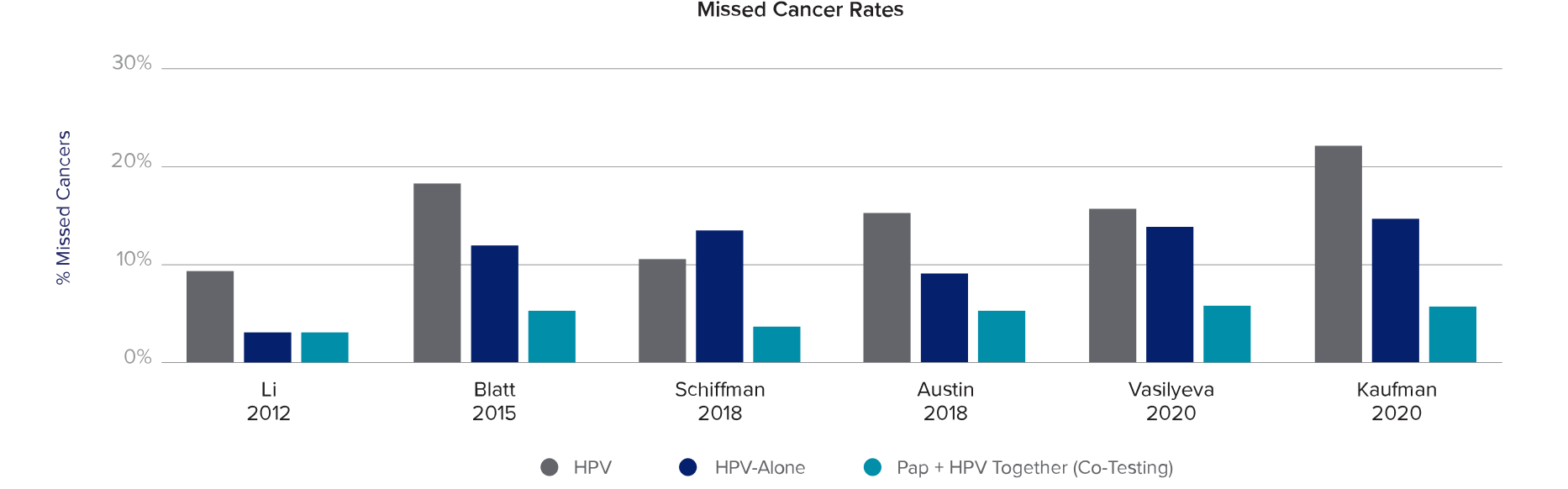
Pap + HPV (Co-Testing) Missed the Fewest Cancers and Pre-Cancers5

Key Study from 2020-Kaufman (Quest)5

This study is the largest, most diverse U.S. cervical screening population reported to date, with evaluation of co-test results over a 9 year period.5

Missed Cancers and Pre-Cancers

Several Clinical Studies Showed, Screening with HPV- Alone Misses Cervical Cancer5-8, 11-15

HPV Negative Cancer Cases

Multiple Studies Show Pap + HPV Together (Co-Testing) Consistently Outperforms5-10
Pap & HPV Together

Retrospective longitudinal study of cervical cancer screening involving:

  • Women 30–65 years of age
  • 1,615 co-tests preceding 1,259 cases of cervical cancer
  • 11,164 co-tests preceding 8,048 precancer diagnoses (CIN3/AIS)

Head-to-head performance matched to longitudinal biopsy

  • Pap- Alone
  • HPV- Alone
  • Pap + HPV (co-testing)

Key Findings from Multiple Screening Studies

1 in 5

cervical cancers were missed with HPV- Alone‡7,8

70%

of the cancers missed by HPV- Alone were identified by Pap + HPV (Co-testing)‡5

95%

of cervical cancers were detected with Pap + HPV (Co-testing)7,8

What About HPV Self-Collect?

A self-collect vaginal swab is collected by the patient in a healthcare or private setting and for individuals not currently participating or engaging in routine screening.16-18 Clinician-collected cervical samples are preferred by American Society for Colposcopy and Cervical Pathology (ASCCP).19

Risk of Missed Disease

“… the primary risk associated with self-collected vaginal specimens may arise if regularly-screened individuals electively switch from clinician-collected cervical specimens to self-collected vaginal specimens, which could result in potential missed cervical cancer disease cases that could have otherwise been detected and prevented using the current standard of care (i.e., clinical-collected cervical specimens).” —FDA17,18

Clinician-Collected Cervical Samples Remain the Standard of Care

“…self-collect vaginal specimens appear less sensitive and specific in comparison to clinician-collected cervical specimens.” —FDA regarding HPV self-collect17,18

HPV Self-Collection Comes with Trade-Offs19

Loss to Follow-Up

There is nearly 4x more loss to patient follow-up compared to clinician collection.

Triage Testing

Additional testing not possible with vaginal specimen. Positive results require clinician cervical exam or speculum specimen collection.

Repeat Testing

Self-collected tests are recommended every 3 years following negative results.

Cytology is Needed in the Following Scenarios:19

  • HPV 16/18 positive: requires immediate diagnostic evaluation (e.g. colposcopy) and ongoing surveillance§
  • HPV-positive, genotype unknown
  • HPV HR12 (other) positive
  • HPV 45, 33/58, 31, 52, 35/39/68, 51 positive
  • Symptomatic patients
  • Immunocompromised patients
  • During surveillance

HPV Self-Collection: A Step Forward or a Step Back?

The Netherlands HPV Self-collect Case Study

%

decline in screening participation from 2017–202220-22

%

of patients did not follow up after receiving a positive hrHPV test result23

%

decreased sensitivity vs. clinician sampling in an adjusted population23

Patient

Most patients still prefer to visit their GP20

Self sample

Self-sampling is increasing, however, most self samplers are “switchers” who previously received a pap test, rather than new, untested patients23

Support Patient Preference With Clinician-Collected Co-Testing24

Care Icon

Co-testing was a preferred screening method among adequately and under-screened women

STI Virus Vector

HPV self-collect was the least preferred method of screening among adequately screening women

Money Down Icon

Under-screened women prefer co-testing over HPV self-collect

Ovaries Vector

All women regardless of screening modality prefer to start screening at the age of 21

The Affordable Care Act Covers Many Co-Testing Cases

For patients this may mean:25

No Copay_icon

No co-pay

No Deductable_icon

No deductible

No OOP cost_icon

No out-of-pocket cost

Note: Patients should consult their healthcare plans to verify coverage

Hologic’s Offerings

Our suite of testing tools leads the market in accuracy and sensitivity, providing the insights you need for your patient’s best care.

Aptima® HPV 16 18/45 Assays

Aptima® HPV 16 18/45 Assays

Detects high-risk HPV types with high sensitivity and specificity to identify women at risk for cervical disease.

ThinPrep® Pap test

ThinPrep® Pap test

Liquid-based cytology for early detection of cervical cytologic abnormalities, including precancer and cancer.

Let’s Connect

Have a question or need to talk to a Hologic team member? We’re here to help.

*Average annual rate per 100,000, age adjusted to the 2000 U.S. standard population.

There are two additional screening methodologies also recommended in this age group. For more information, see the April 2021 ACOG Practice Advisory.

A positive HPV screening result may lead to further evaluation with cytology and/or colposcopy.

§As described in the 2019 ASCCP guidelines, collection of cervical cytology at the colposcopy visit is recommended because additional diagnostic testing and surveillance are required.


1. American Cancer Society. The Pap (Papanicolaou) Test. Revised February 13, 2025. Accessed November 7, 2025. https://www.cancer.org/cancer/cervical-cancer/detection-diagnosis-staging/screening-tests/pap-test.html

2. NIH. Surveillance, Epidemiology, and End Results (SEER) Program SEER*Stat Database: Incidence – SEER Research Data, 8 Registries, Nov 2024 Sub (1975-2022) – Linked To County Attributes – Time Dependent (1990-2023) Income/Rurality, 1969-2023 Counties, National Cancer Institute, DCCPS, Surveillance Research Program, released April 2025, based on the November 2024 submission. Released April 21, 2025. Accessed November 7, 2025. https://seer.cancer.gov/statfacts/html/cervix.html

3. American Cancer Society. Cancer Statistics Center. Accessed November 7, 2025. https://cancerstatisticscenter.cancer.org/types/cervix

4. USPSTF. Cervical Cancer: Screening. U.S. Preventative Services Task Force website. Reviewed August 21, 2018. Accessed November 7, 2025. https://www.uspreventiveservicestaskforce.org/uspstf/recommendation/cervical-cancer-screening

5. Kaufman et al. Contributions of Liquid-Based (Papanicolaou) Cytology and Human Papillomavirus Testing in Cotesting for Detection of Cervical Cancer and Precancer in the United States. Am J Clin Pathol 2020;XX:0-0

6. Li Z, et al. Screening test results associated with cancer diagnoses in 287 women with cervical squamous cell carcinoma. ArchPathol Lab Med.
2012;136:1533-1540. doi: 10.5858/arpa.2011-0609-OA. (Study included ThinPrep, SurePath, Hybrid Capture 2, cobas HPV assay, Cervista HPV HR test)

7. Blatt AJ, et al. Comparison of cervical cancer screening results among 256,648 women in multiple clinical practices. Cancer Cytopathol. 2015;123(5):282-288. doi:10.1002/cncy.21544. (Study included ThinPrep®, SurePath and Hybrid Capture 2 High-Risk HPV DNA test).

8. Austin et al. Enhanced Detection of Cervical Cancer and Precancer Through Use of Imaged Liquid-Based Cytology in Routine Cytology and HPV Cotesting. Am J Clin Patho 2018; 150:385-392

9. Schiffman M, et al. Relative Performance of HPV and Cytology Components of Cotesting in Cervical Screening. J Natl Cancer Inst. 2018; 110(5):501-508. doi: 10.1093/jnci/djx225 (Study included conventional cytology, SurePath Pap test and Hybrid Capture)

10. Vasilyeva D. et al. Negative Roche cobas HPV testing in cases of biopsy-proven invasive cervical carcinoma, compared to Hybrid Capture 2 and liquid-based cytology. JASC 2020, doi: https://doi.org/10.1016/j.jasc.2020.08.006. 1

11. Katki HA, et al. Cervical cancer risk for women undergoing concurrent testing for human papillomavirus and cervical cytology: a population-based study in routine clinical practice. Lancet Oncol. 2011;12(7):663-672. doi:10.1016/S1470-2045(11)70145-0 (Study included conventional Pap, Hybrid Capture 2 assay).

12. Zhao Y, et al. Relationship between cervical disease and infection with human papillomavirus types 16 and 18, and herpes simplex virus 1 and 2. J Med Virol. 2012;84:1920-1927. doi.org/10.1002/jmv.23353 (Study included ThinPrep and Seaman triplex real-time PCR assay).

13. Zhao C, et al. Cervical screening test results associated with 265 histopathologic diagnoses of cervical glandular neoplasia. Am J Clin Pathol. 2013;140:47-54. Published 2013. Accessed November 24, 2020. doi.org/10.1309/AJCPIP9M8HPVBSSC (Study included ThinPrep and Hybrid Capture 2 assay).

14. Zhao C, et al. Prior high-risk human papillomavirus testing and Papanicolaou test results of 70 invasive cervical carcinomas diagnosed in 2012. Arch Pathol Lab Med. 2014;184-188. doi: 10.5858/arpa.2014-0028-OA (Study included ThinPrep, SurePath, Hybrid Capture 2 assay, Cervista Assay, and cobas assay).

15. Gage J, et al. Reassurance against future risk of precancer and cancer conferred by a negative human papillomavirus test. J Natl Cancer Inst. 2014;106(8). doi:10.1093/jnci/dju153 (Study included conventional Pap, Hybrid Capture® 2 assay).

16. Food and Drug Administration (FDA). SSED: Human Papillomavirus (HPV) DNA Detection kit for BD Onclarity HPV Assay. Template. Premarket Approval Application P160037/ S017. Published May 2024.

17. Food and Drug Administration (FDA). SSED: Human Papillomavirus (HPV) DNA Detection kit for cobas HPV (4800). Template. Premarket Approval Application P100020/S055. Published May 2024.

18. Food and Drug Administration (FDA). SSED: Human Papillomavirus (HPV) DNA Detection kit for cobas HPV (5800/6800/8800). Template. Premarket Approval Application P190028/S009. Published May 2024.

19. Wentzensen N, Massad LS, Clarke MA, Garcia F, Smith R, Murphy J, Guido R, Reyes A, Phillips S, Berman N, Quinlan J, Lind E, Perkins RB; Enduring Consensus Cervical Cancer Screening and Management Guidelines Committee. Self-Collected Vaginal Specimens for HPV Testing: Recommendations From the Enduring Consensus Cervical Cancer Screening and Management Guidelines Committee. J Low Genit Tract Dis. 2025 Apr 1;29(2):144-152. doi: 10.1097/LGT.0000000000000885. Epub 2025 Feb 21. PMID: 39982254; PMCID: PMC11939108.

20. Aitken CA, Kaljouw S, Siebers AG et al. Investigating the decrease in participation in the Dutch cervical cancer screening programme: The role of personal and organisational characteristics. Prev Med Rep. 2021;22:101328.

21. Monitor national cervical cancer screening programme 2021. 2022;1-12. National Institute for Public Health and the Environment. https://www.rivm.nl/en/documenten/ monitor-national-cervical-cancer-screening-programme-2021.

22. Monitor national cervical cancer screening programme 2022. 2023;1-15. National Institute for Public Health and the Environment. https://www. rivm.nl/documenten/monitor-national-cervical-cancer-screening-programme-2022.

23. Aitken CA, Inturrisi F, Kaljouw S et al. Sociodemographic Characteristics and Screening Outcomes of Women Preferring Self-Sampling in the Dutch Cervical Cancer Screening Programme: A Population-Based Study. Cancer Epidemiol Biomarkers Prev. 2023;32(2):183-192. doi:10.1158/1055-9965.EPI-22-0712

24. Zhu P, Tatar O, Haward B, Griffin-Mathieu G, Perez S, Smith L, Brotherton J, Ogilvie G, Rosberger Z. Assessing Canadian women’s preferences for cervical cancer screening: A brief report. Front Public Health. 2022 Jul 28;10:962039. doi: 10.3389/fpubh.2022.962039. PMID: 35968487; PMCID: PMC9366717.

25. CDC. Prevention Through Health Care: Preventive Service Tables. HPV. https://www.cdc.gov/nchhstp/preventionthroughhealthcare/preventiveservices/std.htm. Updated May 2, 2018. Accessed January 28, 2024.